
Why Pigeons Keep Coming Back to Your North York Condo Balcony

You shoo them away. They come back. You try noise, reflective tape, plastic owls. They come back. If you own a condo in North York and pigeons keep returning to your balcony, you are not dealing with a random nuisance. You are dealing with a behavioural pattern that is deeply rooted in how pigeons think, navigate, and survive in urban environments.
North York’s high-density residential corridors along Yonge Street, Sheppard Avenue, and the Willowdale and Newtonbrook neighbourhoods are home to thousands of condo units, many of which face recurring pigeon problems that temporary deterrents simply cannot resolve. This article explains the science behind why pigeons return, what specific conditions in North York make the problem worse, and what actually works to stop the cycle permanently.

The Science of Why Pigeons Return
Pigeons are not wandering birds. Unlike many urban species that move opportunistically through a city, pigeons are highly territorial and site-faithful. Once a pigeon identifies a balcony as a reliable resource, whether for food, shelter, warmth, or nesting potential, it encodes that location into its spatial memory with remarkable precision. Research on pigeon navigation has consistently shown that these birds can return to a specific location from distances exceeding 1,000 kilometres. Your balcony on the 18th floor of a North York tower is not a challenge for their navigation system.
This behaviour is reinforced through a process called site fidelity. Every time a pigeon successfully lands on your balcony and finds it safe and rewarding, the neural pathway associated with that location strengthens. Chasing the bird away does not erase that pathway. It simply delays the next visit. Over time, repeated successful returns reinforce the association, and the pigeon begins treating your balcony as a core part of its daily territory.
Nesting amplifies this dynamic significantly. A pigeon that has nested on a balcony once will attempt to return to that exact location in subsequent breeding seasons, which in Toronto can occur two to four times per year. If the original nest is removed but the access point remains open, the bird will rebuild within days. This is why homeowners and condo residents across North York report that cleaning the balcony or removing nesting materials produces only short-term relief.
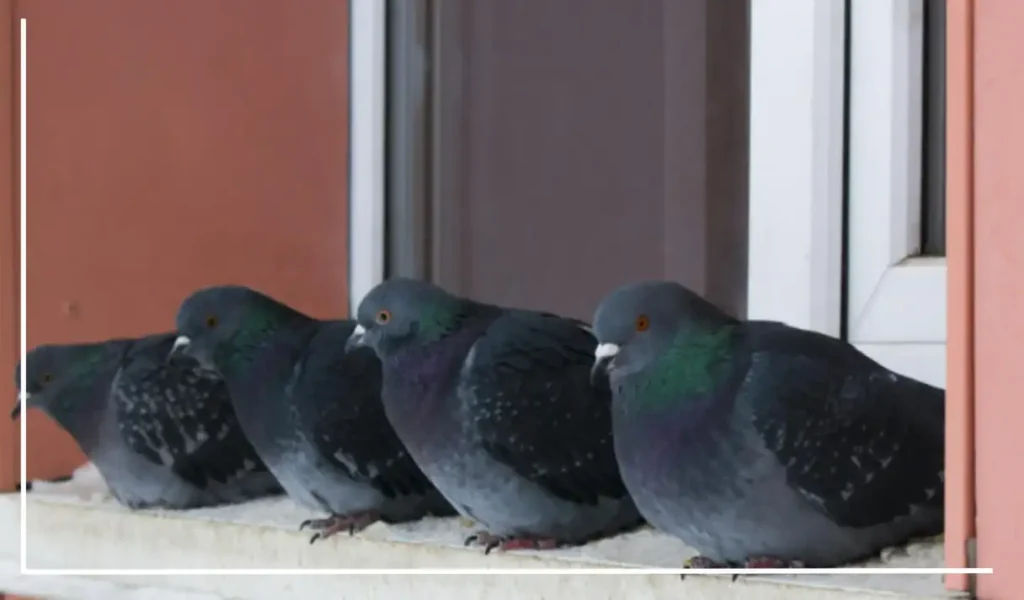
Why North York Condos Are Particularly Vulnerable
Not all condo buildings experience pigeon problems equally. North York has a specific combination of urban geography, building design, and environmental factors that make its residential towers more attractive to pigeons than many other parts of the GTA.
Building Height and Sun Exposure
North York’s residential towers along Yonge Street between Sheppard and Finch, and along the Sheppard Avenue corridor near North York Centre, are among the tallest residential structures in the GTA outside of downtown Toronto. Pigeons prefer elevated roosting positions because height provides safety from ground-level predators and clear sightlines for monitoring the surrounding area. High-rise balconies in North York are ideal from the pigeon’s perspective, particularly those on south and west-facing units that receive extended afternoon sun. Warm, sun-exposed concrete surfaces attract pigeons during cooler months when thermal comfort is a priority.
Proximity to Green Corridors
North York sits adjacent to one of Toronto’s most significant natural systems. The ravine network that runs through the Don River Valley, along with Earl Bales Park on Bathurst Street and G. Ross Lord Park further north, provides pigeons with natural habitat, water sources, and food close to the high-density residential zones. Pigeons move daily between these green corridors and the surrounding towers, using balconies along the route as rest stops and nesting platforms. Condo buildings within a few blocks of these parks, particularly those along Bayview Avenue and Leslie Street, report consistently higher pigeon activity than buildings further from the ravine system.
Food Availability on the Sheppard and Yonge Corridors
The intersection of Yonge and Sheppard is one of the most commercially active intersections in North York. The surrounding blocks are dense with restaurants, food courts, grocery stores, and pedestrian plazas where food debris accumulates. Mel Lastman Square and the North York Civic Centre plaza are well-known gathering points for pigeons precisely because of the consistent food availability in the area. Condo residents within a 500-metre radius of this intersection face higher pigeon pressure than those in quieter residential pockets further north in Willowdale or Newtonbrook.
Building Age and Balcony Design
Many of North York’s residential towers were built during the construction boom of the 1970s and 1980s. The balcony designs common to this era feature wide concrete soffits, deep overhangs, and open corners that create naturally sheltered spaces attractive to nesting pigeons. Newer towers built in the 2000s and later tend to have narrower balconies with less overhead shelter, which provides a less hospitable nesting environment. If your building predates 1990, the balcony architecture itself is likely contributing to the problem.
Why Temporary Deterrents Stop Working
Most condo residents in North York who contact Pigeon Control Toronto have already tried one or more temporary deterrents before seeking professional help. Understanding why these methods fail is important before investing further time or money in approaches that will not produce lasting results.
Reflective Tape and Visual Scare Devices
Reflective tape, hanging CDs, and predator decoys such as plastic owls and hawk silhouettes work on the principle of creating visual discomfort. Pigeons initially avoid unfamiliar or potentially threatening stimuli. However, pigeons are highly intelligent birds with well-documented habituation responses. Within days to weeks of installation, they recognize that the device poses no real threat and resume normal behaviour around it. On a high-rise balcony in North York where the bird has strong site fidelity, habituation to visual deterrents typically occurs within one to three weeks.
Sound Devices
Electronic sound deterrents that emit distress calls or predator sounds face the same habituation problem as visual devices, with an additional challenge. North York’s urban soundscape along Yonge Street and Sheppard Avenue is already saturated with traffic noise, construction, and ambient city sound. Pigeons that have adapted to this environment are not reliably startled by additional sound stimuli, particularly when those sounds repeat on a predictable cycle, which most consumer devices do.
Physical Barriers Without Professional Installation
Some condo residents attempt DIY netting or mesh installations using materials purchased at hardware stores. These installations frequently fail because the net is not properly tensioned, attachment points are inadequate for outdoor conditions, or gaps are left at corners and edges that pigeons exploit immediately. A poorly installed net can also create a trap where birds enter through a gap and cannot exit, which creates a welfare issue and a more serious infestation problem inside the net.
What Actually Works: Professional Physical Exclusion
The only method that reliably stops pigeons from returning to a specific location is permanent physical exclusion. This means installing a professionally designed barrier that prevents the bird from accessing the protected area entirely, eliminating the possibility of reinforcing the site fidelity behaviour that drives the return cycle.
Pigeon Netting for North York Condos
Professional pigeon netting installed by Pigeon Control Toronto uses a stainless steel cable framework tensioned across the balcony opening, over which a UV-resistant polyethylene net is fitted. The system covers the full balcony perimeter with no gaps at corners, edges, or overhead surfaces. Once installed, there is no entry point for pigeons to exploit, and the site fidelity behaviour has nowhere to attach. Over time, without successful access to the balcony, the bird’s association with the location weakens and it redirects its territory to other surfaces.
For North York condo buildings, we work within the specifications of each building’s exterior requirements. Pigeon Control Toronto has completed installations across numerous residential towers in the Yonge and Sheppard corridor, Willowdale, and Newtonbrook, and we coordinate directly with property management and condo boards to ensure all work meets building standards.
Balcony Netting vs. Other Methods
Balcony netting outperforms all alternative methods for one fundamental reason: it removes access entirely rather than attempting to discourage a bird whose site fidelity is already established. Bird spikes are effective on specific ledges and surfaces but do not cover the full balcony space. Optical gel provides a deterrent effect on treated surfaces but is subject to the same habituation limitations as other deterrents over time. For a condo resident in North York dealing with pigeons that have already established site fidelity, full netting is the appropriate solution.
Cleaning Before Installation
Before netting is installed, existing droppings and nesting materials must be professionally removed. Pigeon Control Toronto provides balcony cleaning services that safely eliminate biological waste using appropriate protective equipment and disinfectants. Removing the scent markers left by previous pigeon activity is an important step in breaking the site fidelity cycle, as pigeons use olfactory cues in addition to visual memory when navigating back to familiar locations.
Frequently Asked Questions
These are the questions North York condo residents ask us most often when dealing with recurring pigeon problems.
Q1. The pigeons on my balcony are not nesting yet. Should I still act now?
Yes. A pigeon that visits your balcony regularly but has not yet nested is in the process of evaluating it as a nesting site. Intervening before nesting begins is significantly easier and less costly than addressing an established nest. Once eggs are laid, Ontario wildlife regulations may restrict removal during the active nesting period. Acting at the first sign of regular pigeon visits prevents the site fidelity association from strengthening and avoids the more complex removal process associated with active nests.
Q2. I live on the 25th floor. Can pigeons really reach my balcony?
Yes. Pigeons are strong fliers with no practical altitude limitation within the height range of residential towers in North York. High-rise balconies are not protected by elevation. In fact, upper-floor balconies are often preferred by pigeons because the height provides the safety and sightline advantages they instinctively seek. Pigeon Control Toronto regularly performs installations on balconies above the 20th floor in towers along the Yonge and Sheppard corridor.
Q3. My condo board has not approved netting yet. What can I do in the meantime?
While awaiting board approval, avoid leaving any food, water, or open containers on the balcony. Remove any existing nesting materials promptly using gloves and a mask. Do not place furniture or storage items that create sheltered corners where pigeons can nest undisturbed. These measures will not eliminate the problem but may slow its progression while the approval process moves forward. Pigeon Control Toronto can provide your board with full documentation to support the approval application, including product specifications, installation methods, and insurance certificates.
Q4. Will the netting affect my view or block natural light?
No. The netting system installed by Pigeon Control Toronto uses a thin-gauge black polyethylene mesh that is virtually invisible from inside the unit and from street level. The stainless steel cable framework is low-profile and attaches without drilling through finished surfaces. Natural light and airflow are not affected. We have completed installations on balconies throughout North York’s residential towers without any impact on the unit’s aesthetics or livability.
Q5. How long does it take for pigeons to stop returning after netting is installed?
Once netting is installed with no gaps, pigeons typically attempt to access the balcony several times over the first few days before redirecting to other locations. The process varies depending on how strongly the site fidelity association is established. Birds that have nested on the balcony previously may persist longer than occasional visitors. In most cases, regular return attempts cease within one to two weeks of a complete exclusion installation. The key is that the net covers all access points with no exceptions, as a single gap will be found and exploited.
Stop the Return Cycle for Good
If pigeons keep coming back to your North York condo balcony despite your efforts, the problem is not a lack of effort on your part. It is the nature of pigeon behaviour combined with conditions that make your balcony an attractive target. Professional physical exclusion is the only method that addresses the root cause.
Pigeon Control Toronto serves condo residents across North York, including Willowdale, Newtonbrook, Bayview Village, and the Yonge and Sheppard corridor, as well as the full Greater Toronto Area. Contact us today for a free assessment and written quote.