
I Found a Baby Pigeon on My Toronto Balcony: What Should I Do?

You walked out onto your balcony and found a baby pigeon sitting there. It looks helpless. You are not sure if it is injured, abandoned, or if the parents are nearby.
This is a common situation for residents across Toronto. It happens on balconies in Scarborough, North York, Etobicoke, and downtown condos near the CN Tower and Harbourfront. Spring and summer bring nesting season, and urban pigeons have learned that Toronto balconies are safe, warm, and sheltered.
Here is what you need to know, step by step.
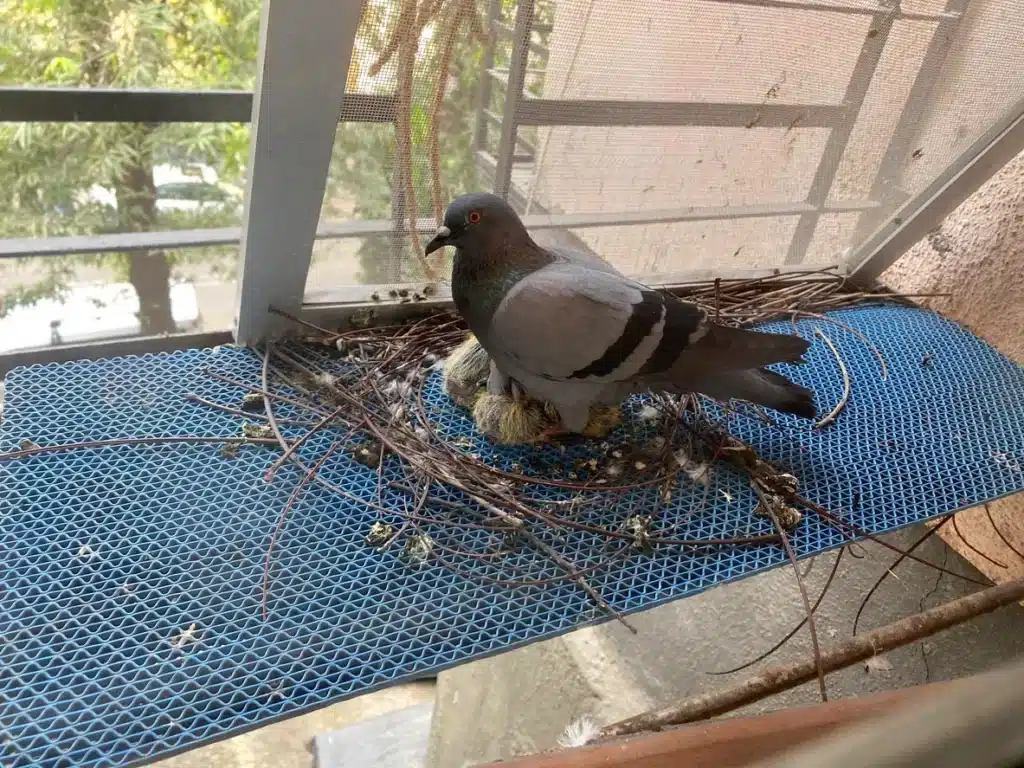
First: Is It Actually a Baby Pigeon?
Baby pigeons, called squabs, look very different from adult birds. In their first two weeks of life they are mostly featherless, with yellowish down and closed or barely open eyes.
By three to four weeks, they develop adult-looking feathers but remain smaller than a full-grown pigeon. At this stage they are called fledglings. They may hop around and appear unable to fly, but this is normal development.
A fledgling on your balcony is not necessarily lost or injured. It may simply be learning to navigate its environment before its first full flight.
Second: Do Not Pick It Up Right Away
The instinct is to help. But handling a baby pigeon unnecessarily can cause stress that harms the bird.
Before touching it, observe from a distance for 30 to 60 minutes. Watch whether adult pigeons are returning to the area. Parent pigeons in Toronto do not abandon their young easily. They are often nearby, waiting for you to move away before returning to feed the chick.
If the bird is in an open area of the balcony and appears alert, it is likely fine. If it is visibly injured, bleeding, or has been there for several hours without any parent activity, it may need help.
Third: Know What Ontario Law Says
In Ontario, pigeons are not a protected species under the Fish and Wildlife Conservation Act. However, disturbing an active nest with eggs or very young chicks is subject to local bylaws and ethical guidelines in Toronto.
The Toronto Wildlife Centre, located near Downsview Park in North York, is the most established resource in the city for injured or orphaned urban wildlife. They handle pigeon-related calls regularly and can advise you on whether intervention is appropriate for your specific situation.
The Toronto Humane Society, based on River Street in the East End, also provides guidance for urban wildlife encounters. Both organizations recommend against relocating a baby pigeon unless it is clearly injured or in immediate danger.
What To Do If the Bird Needs Help
If after observation you determine the bird is injured or genuinely abandoned, here is what to do.
- Place the bird gently in a small cardboard box lined with paper towel. Do not use fabric, as small claws can get caught.
- Keep the box in a quiet, warm area away from pets and children.
- Do not give the bird food or water. Incorrect feeding can cause serious harm.
- Contact the Toronto Wildlife Centre at 416-631-0662 for guidance on next steps.
- Do not attempt to raise the bird yourself. Urban pigeons require specific care that untrained individuals cannot safely provide.
The Bigger Issue: Why Baby Pigeons Appear on Toronto Balconies
Finding a baby pigeon on your balcony is a sign that pigeons have been nesting nearby, possibly on your own balcony or on an adjacent ledge.
In high-density areas like Liberty Village, Yonge and Eglinton, and the condo corridor along Lake Shore Boulevard West in Etobicoke, pigeons nest in the gaps between buildings, on rooftop mechanical equipment, and on balcony ledges throughout the spring and summer months.
Once a nesting site is established, birds return to it repeatedly. Each breeding cycle, which can occur two to four times per year in the Toronto area, produces new squabs. If you found one on your balcony today, you are likely to find more later in the season.
This is the point where many Toronto residents decide to address the underlying problem rather than manage each incident individually.
Preventing Future Nesting on Your Balcony
The most effective way to stop pigeons from nesting on your balcony is physical exclusion. This means installing a barrier that prevents birds from accessing the space entirely.
Professional pigeon netting installation creates a complete seal across the balcony opening. No entry means no nesting, no eggs, and no baby pigeons on your floor in April.
For specific ledges and railings where birds land before accessing the balcony, stainless steel spike systems remove the landing surfaces pigeons depend on. Spikes are a practical first step for early-stage problems.
Both solutions are humane. They do not harm birds. They simply remove the conditions that make your balcony attractive as a nesting site.
Pigeon Control Toronto: Here to Help
Pigeon Control Toronto is a professional bird control company serving condos, homes, and commercial properties across the Greater Toronto Area.
We work with condo residents, property managers, and building owners in Downtown Toronto, Scarborough, North York, Etobicoke, Mississauga, Brampton, Pickering, Ajax, Oshawa, Hamilton, and Burlington.
Our team installs professional netting, spikes, optical gel, and bird wire systems that prevent pigeons from nesting on your property. We also provide professional balcony decontamination to safely remove droppings and nesting materials before installation.
If you found a baby pigeon on your balcony and want to make sure it does not happen again, we can help.
Get in touch with our team for a free on-site assessment. We will evaluate your balcony, identify the nesting risk, and recommend the right solution for your property.
Frequently Asked Questions
Can I move a pigeon nest from my Toronto balcony?
If the nest contains eggs or very young chicks, it is best to wait until the current nesting cycle is complete before removing it. Once the nest is empty, remove it immediately and install physical deterrents to prevent the birds from rebuilding. Contact Pigeon Control Toronto for professional removal and exclusion installation.
Will the parent pigeons come back if I touch the baby?
Yes. Unlike some bird species, pigeons do not abandon their young due to human scent. If you need to move the bird to a safer spot on the balcony, you can do so carefully without worrying that the parents will reject it.
How long until a baby pigeon can fly and leave on its own?
Most baby pigeons reach flight capability at around four to six weeks of age. A fledgling that appears healthy and alert will typically leave the balcony on its own within a few days once it is ready. If the bird remains for more than a week without improvement, contact the Toronto Wildlife Centre for guidance.
Is pigeon droppings on my balcony a health risk?
Yes. Pigeon droppings can contain pathogens including Histoplasmosis and Cryptococcosis. On a balcony where nesting has occurred, droppings accumulate quickly and should be cleaned professionally. Pigeon Control Toronto provides safe balcony cleaning services across Toronto and the GTA before installing bird control systems.
What is the best way to stop pigeons from nesting on my balcony in the future?
Professional pigeon netting is the most reliable long-term solution. It creates a complete physical barrier that eliminates access to the balcony entirely. Pigeon Control Toronto installs netting systems across Toronto and the GTA, working within condo board requirements and building specifications. Contact us for a free assessment.